
Zayo’s 2026 Bandwidth Report shows that AI adoption has permanently shifted how businesses invest in network infrastructure. High-bandwidth solutions like Wavelengths and Metro Dark Fiber remain at record-high demand levels, driven by hyperscaler and carrier investment, enterprise AI workloads, and the rise of AI providers and neoclouds as major bandwidth consumers.
Drawn from real purchasing data across nearly 6,000 customers, Zayo’s 2026 Bandwidth Report makes one thing clear: organizations still planning around pre-AI assumptions are already falling behind.
Here’s a preview of what the report uncovered.
The Challenge: AI Has Rewritten the Rules of Network Planning
The network infrastructure conversation has changed. It used to center on keeping up and provisioning enough bandwidth to handle today’s traffic, but that approach no longer works. AI has rewritten the rules, and the data from our 2026 Bandwidth Report makes that shift impossible to ignore.
Today’s AI workloads, including large model training, real-time inference, and distributed compute, generate massive, sustained data flows between data centers, colocation facilities, cloud regions, and edge nodes. These workloads don’t create temporary spikes and then subside. They run continuously at a scale that legacy network architectures were never designed to support.
The consequences are real:
- Enterprises risk hitting capacity ceilings at exactly the moment they need to scale AI deployments.
- Network bottlenecks slow AI initiatives, delay time-to-value, and increase operational risk.
- Organizations that planned for “normal” growth are now scrambling to retrofit infrastructure that wasn’t built for intelligence-era workloads.
The 2026 Bandwidth Report quantifies these pressures and reveals how leading organizations are responding.
Steady Bandwidth Growth Is Over
After record-high bandwidth investments in 2024, demand remained consistently elevated throughout 2025. This isn’t a temporary spike. It’s a structural shift.
Organizations are going beyond adding more capacity and redesigning entire network architectures to support AI workloads, distributed computing, and data-intensive applications that require dramatically more throughput than traditional enterprise environments.
Key data points from the report:
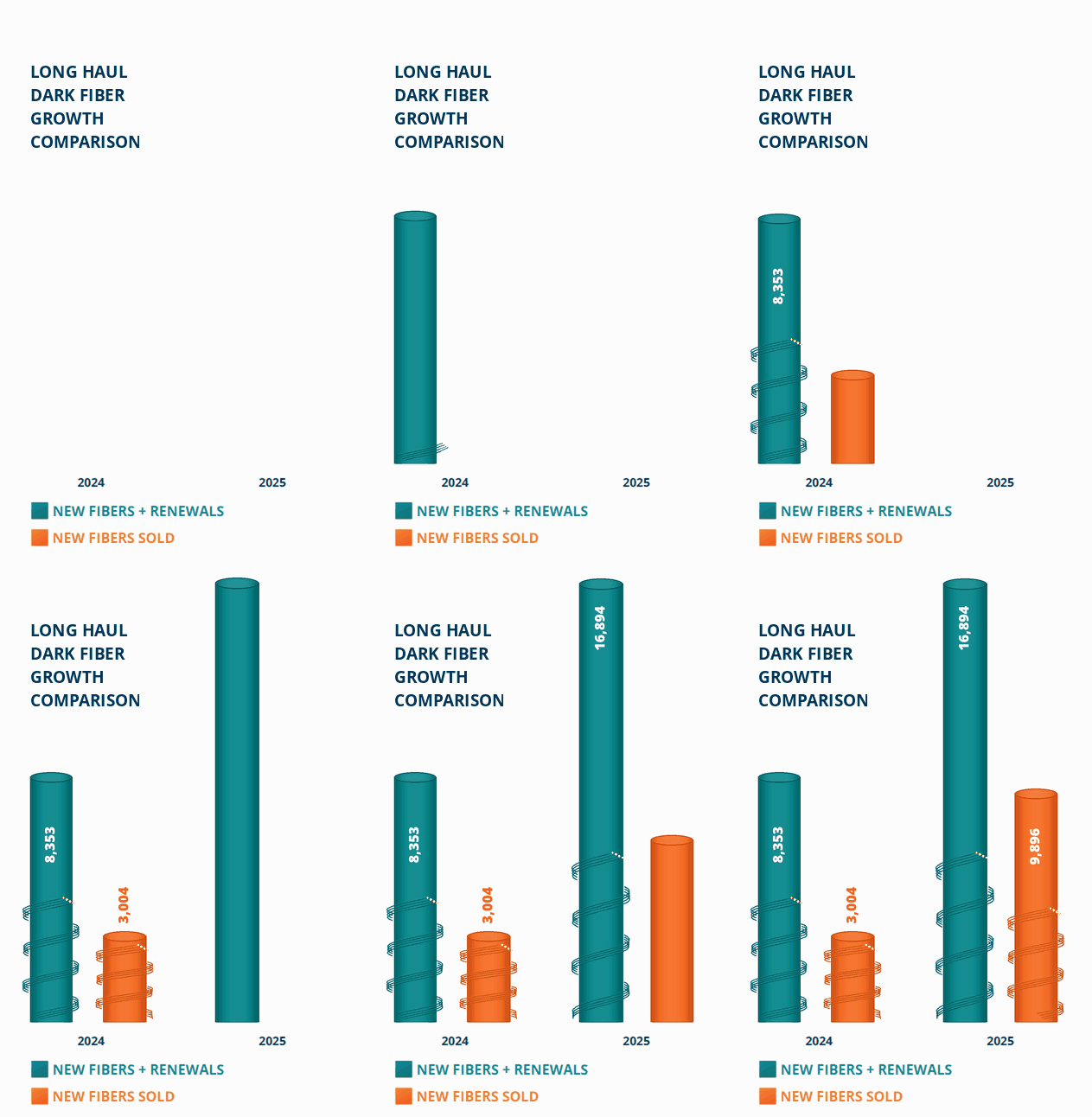
- Between 2024 and 2025, demand for Long Haul Dark Fiber doubled as our biggest customers connected critical AI data centers with fast, reliable, high-capacity infrastructure.
- Investments in high-bandwidth solutions, including Wavelengths and Metro Dark Fiber, remained at high demand levels throughout 2025.
The report digs into why this sustained demand signals a permanent inflection point, and what it means for long-term network planning.
Enterprises Are Buying Different Products, Not Just More Bandwidth
Enterprise AI adoption is no longer experimental. Across financial services, healthcare, manufacturing, and retail, organizations are embedding AI into core business processes:
- Fraud detection and real-time risk modeling
- Clinical decision support and diagnostic imaging
- Predictive maintenance and factory automation
- Personalized customer experiences at scale
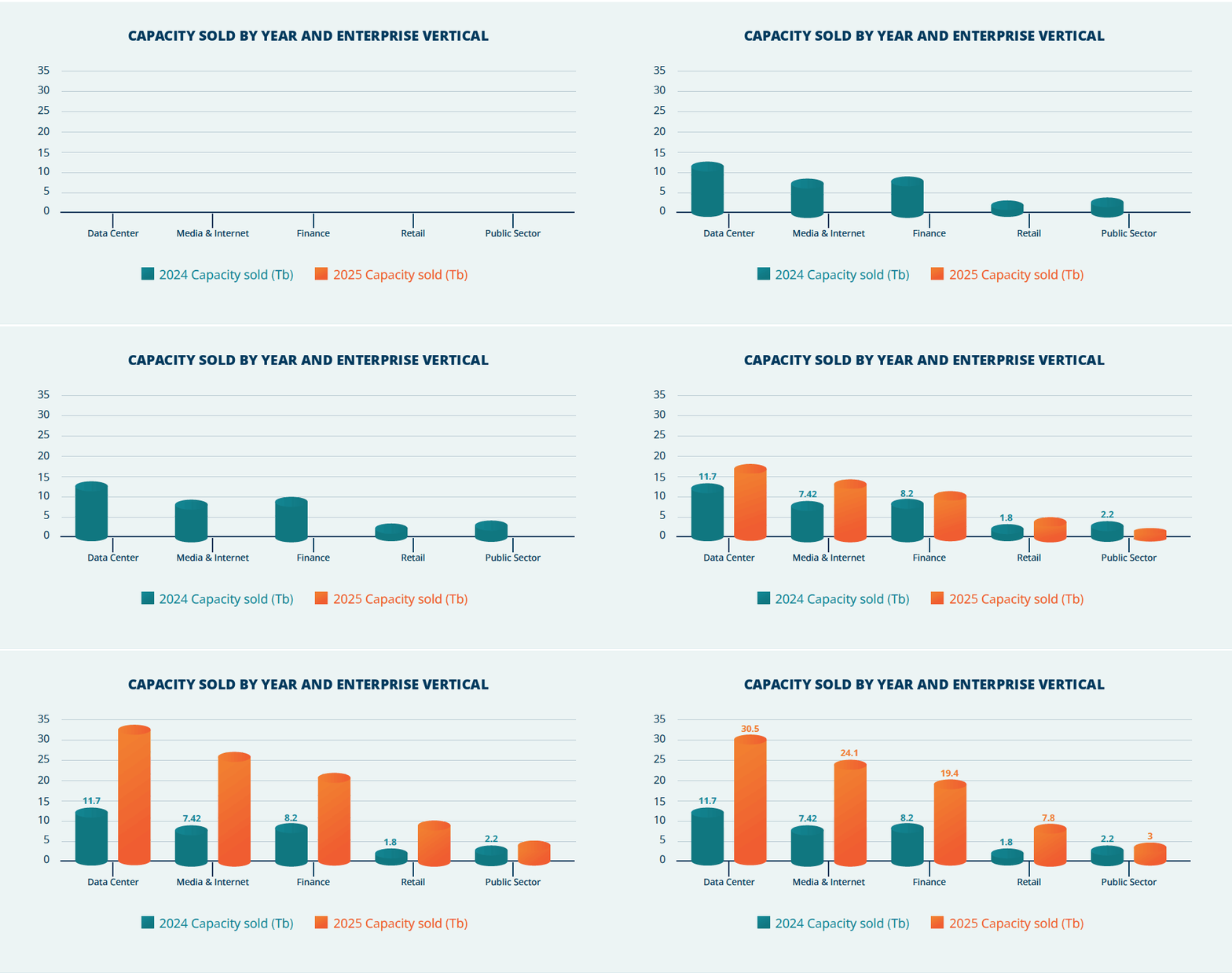
Each of these use cases generates continuous, high-volume data movement that legacy infrastructure can’t reliably support. As a result, enterprises are buying more bandwidth and buying different kinds of bandwidth, prioritizing dedicated, low-latency connections designed for the real-time data flows that AI applications depend on.
AI Providers and Neoclouds Are Reshaping Demand
Hyperscalers and carriers remain the dominant force in long-haul dark fiber investment, accounting for 95% of all long-haul purchases. But a new trend is emerging.
AI providers and neoclouds are proving to be a powerful new category of bandwidth consumers. Unlike traditional hyperscalers, this segment scales rapidly with a singular focus on AI compute. Their infrastructure requirements are intense:
- High-density GPU clusters requiring massive interconnect bandwidth
- Low-latency connectivity between facilities to support model training and inference
- Scalable, flexible network architectures that can expand as compute capacity grows
As this segment grows, its impact on bandwidth demand is impossible to overlook. The 2026 Bandwidth Report tracks how this shift is reshaping investment patterns across the market.
Regional Demand Patterns Are Shifting
AI infrastructure buildout isn’t evenly distributed. Certain markets are emerging as critical hubs for AI compute and interconnection, driven by access to power, fiber density, and proximity to major cloud on-ramps.
Understanding where demand is concentrating, and why, is essential for organizations making long-term infrastructure decisions.
“We are seeing the strongest growth in metro markets where data center density, cloud connectivity, and AI workloads are converging. Demand is increasingly tied to proximity, where data is created, processed, and consumed, which is driving investment into dense metro fiber networks,”
– Mike Kozlowski, Head of Product Management for Metro Dark Fiber at Zayo.

What This Means for Your Organization
The data from the 2026 Bandwidth Report points to a clear conclusion: the organizations best positioned for AI-driven growth are those that made strategic infrastructure investments before they felt constrained.
If your organization still operates on pre-AI network assumptions, the window to course-correct is narrowing. The right connectivity infrastructure, scalable, low-latency, and purpose-built for intelligence-era workloads, isn’t just a technical decision. It’s a competitive one.
Questions worth asking now:
- Does your current network architecture support the sustained, high-volume data flows that AI workloads require?
- Are you relying on shared or legacy infrastructure that could bottleneck AI deployment at scale?
- Do you have the flexibility to scale connectivity capacity as your AI initiatives grow?
Download the Full 2026 Bandwidth Report
This post covers the headline findings, but the complete analysis is in the report itself.
Zayo’s 2026 Bandwidth Report includes:
- Detailed investment trend data across customer segments and industries
- Regional breakdowns showing where bandwidth demand is growing fastest
- Forward-looking analysis of where the market is heading as AI adoption accelerates
- Actionable insights for organizations planning infrastructure investments in 2025 and beyond
If you’re evaluating connectivity options, planning infrastructure investments, or building the network foundation for your AI strategy, this report gives you the data and context to make smarter decisions.