

Every decade or so, a shift arrives that forces enterprises to rethink how they connect, operate, and compete. The network is the center of every application, transaction, and strategic initiative the business depends on.
We are now experiencing the most consequential shift yet: the move to the Intelligence Era. Networks were once pipelines for data. Today, they’re platforms for intelligence, connecting AI systems, automated workflows, connected devices, and real-time data streams that run the modern enterprise.
To see where networks are going, it’s helpful to understand how they got here.
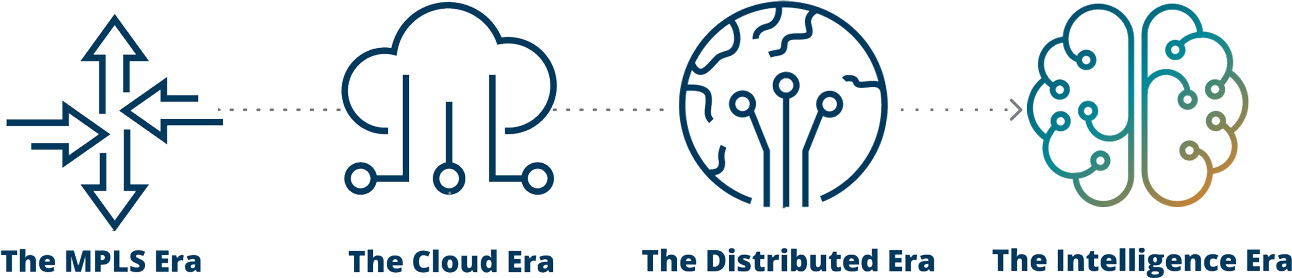
The Four Eras of Enterprise Networking
Enterprise architectures didn’t evolve at random. Each era answered a specific business and technology challenge. Most environments today carry traces of more than one era simultaneously, which makes this progression a practical lens for evaluating your current infrastructure and identifying the gaps.
MPLS (2001), Connecting Locations
Before MPLS (Multiprotocol Label Switching), connecting multiple business locations securely was a logistical burden. Organizations relied on point-to-point models that were hard to manage and harder to scale.
MPLS solved that. It delivered carrier-managed, any-to-any connectivity and gave enterprises a reliable wide area network (WAN) foundation. For companies with branches, offices, and data centers, it was a decisive upgrade.
The Takeaway
The legacy of MPLS is durability. It gave enterprises predictable performance, strong security, and a manageable framework. Many still run MPLS components today, though rarely on their own.
The Cloud Era (2006 to 2007), Connecting Applications
By the mid-2000s, cloud computing, SaaS platforms, and mobile devices pulled applications and data out of the corporate data center. Salesforce, Google Workspace, and early AWS services gave businesses new agility. The cost was complexity.
Networks built around a central data center suddenly had to support users reaching applications across public clouds, private clouds, and third-party environments. The hub-and-spoke model strained under the weight.
The Takeaway
Organizations gained scale, but the network grew harder to manage. Performance, visibility, and security all demanded a rethink. The lesson was clear: as applications move, networks must follow.
The Distributed Era (2020), Connecting Users Everywhere
The shift to hybrid work was already underway. The pandemic accelerated it overnight. Users worked from home, connected to SaaS from personal devices, and reached data spread across clouds, branches, and edge locations.
The perimeter dissolved. IT teams couldn’t assume that users, devices, or applications lived inside a defined boundary. The response was a wave of modern approaches: SD-WAN for software-defined connectivity, SASE (Secure Access Service Edge) for converged networking and security, and Zero Trust frameworks that replaced perimeter trust with identity-based access.
The Takeaway
The Distributed Era changed how and where work happens. The network adapted to meet it.
The Intelligence Era (Today), Connecting Intelligence Everywhere
The Intelligence Era is the most consequential shift yet, and it is happening now. AI, agentic systems, robotics, connected devices, and real-time data operations intertwined intelligence with business processes, customer experiences, and decisions.
This changes what the network is for. Networks aren’t only connecting people to applications anymore. They connect data to AI systems, AI agents to automated workflows, and connected devices to real-time analytics, all at once, with almost no tolerance for latency or disruption.
The Takeaway
To keep pace, enterprise networks must be agile and scalable, capable of supporting growing data volumes, shifting workload demands, and sudden traffic spikes without creating new bottlenecks.
What the Intelligence Era Actually Demands
The answer to the Intelligence Era isn’t a single upgrade. Instead, enterprises need to evolve in response to the four forces simultaneously reshaping the network: hybrid and distributed infrastructure, embedded security, physical-digital convergence, and agentic AI.
- Hybrid and Distributed Infrastructure: Data lives in one location, compute lives in another, and users are somewhere else entirely. AI training runs across metros. Inference moves to the edge. It’s the network’s job to connect all of it with consistent, high-capacity, low-latency paths, or the workload stalls.
- Embedded Security: AI systems talk continuously to other systems, data pipelines, and external APIs. With an attack surface expanding far beyond human users, security can’t be an afterthought. It has to be built into the fabric and protect machine-to-machine communication at scale.
- Physical-Digital Convergence: Intelligence requires deep physical-digital convergence. Real-time operations blur the line between the physical world and the digital one, from sensor data on a factory floor to automated decisions in the cloud. The physical network and the software controlling it must operate as one system, not two.
- Agentic AI: Agentic systems act on their own. They initiate workflows, move data, and make decisions without waiting for a person. Continuous availability and performance are critical, and downtime is an operational risk.
For strategic leaders, the stakes are direct. Operating on outdated network infrastructure will delay automation, limit your ability to turn AI initiatives into business outcomes, and keep you a step behind competitors.
Where Does Your Organization Sit?
Most environments don’t fit neatly into a single era. An organization might run MPLS between key data centers, use SD-WAN across branches, and pilot AI-driven workflows that need a more modern foundation. That is normal.
The goal isn’t to slap a label on your organization. It’s about figuring out where your network’s capabilities line up with your business goals and where they fall short.
- Still relying on MPLS with significant cloud adoption? You are navigating the move from Era One to Era Two.
- Managing a hybrid workforce with distributed applications, but no answer for security and access at the edge? The Distributed Era’s solutions are your priority.
- Actively deploying AI, exploring automation, or building intelligent operations? The Intelligence Era is your horizon, and your network strategy needs to reflect it.
A Practical Model for the Intelligence Era
Recognizing the era is the easy part. Designing for it is harder. Enterprise architects and network leaders need more than a trend. They need a model for how intelligent workflows actually move across the enterprise, and a way to connect that model to real workload requirements.
That is what Zayo’s Intelligent Enterprise Architecture provides.
It starts with three questions, not a product catalog: what needs to connect, why the connection exists, and how the traffic behaves. From there, it maps the answers to a structured architecture built for hybrid infrastructure, embedded security, physical-digital convergence, and agentic AI. It gives architects a repeatable methodology instead of one-off designs, and gives leaders a direct line from strategy to deployment.
Connect. Protect. Operate.
For the teams who run the network every day, the architecture translates into three plain commitments.

Connect. Reach every location, cloud, and edge with high-capacity, low-latency paths that hold up under AI-scale demand.

Protect. Build security into the fabric, covering the machine-to-machine communication that now dominates enterprise traffic.

Operate. Give operations teams the visibility and control to run the network with less manual burden, from a single view across edge, core, and cloud.
Connect. Protect. Operate. turns architecture into action and translates AI investment into business value.
Building a Network Ready for What’s Next
Choosing the right network partner is a strategic business decision. The right partner understands the demands of AI and automation, honestly assesses your current infrastructure, and maps a clear path to modernization that delivers the performance your business needs. And most importantly, the right partner has the infrastructure in place to deliver on their promises.
The Intelligence Era didn’t arrive overnight. Neither did Zayo’s network. Long before AI dominated the headlines, we anticipated the future of data and built our infrastructure accordingly. We built ahead of demand, because when the future arrives, our customers shouldn’t be left waiting for infrastructure to catch up.
Coming Soon: Zayo’s Intelligent Enterprise Architecture
The full guide is coming soon. It lays out the complete architecture for the Intelligence Era: the four forces reshaping enterprise networks, the patterns that connect workloads to real infrastructure needs, and the Connect. Protect. Operate. framework that turns architecture into execution.
Sign up for our newsletter to be among the first to receive the complete Intelligent Enterprise Architecture guide at launch.
Frequently Asked Questions About Enterprise Network Evolution
- What Is the Difference Between MPLS and SD-WAN?
- MPLS is a carrier-managed WAN technology that routes traffic along predetermined paths, offering reliable performance but limited flexibility. SD-WAN (Software-Defined Wide Area Network) uses software to manage connectivity across multiple transport types, including broadband and LTE, providing greater agility, visibility, and cost efficiency. Many organizations are moving from MPLS to SD-WAN or running both in hybrid configurations.
- What Is the Intelligence Era in Enterprise Networking?
- The Intelligence Era is the current phase of network evolution, in which networks serve as platforms for AI, automation, and real-time data operations. Rather than simply connecting users to applications, Intelligence Era networks connect AI systems, automated workflows, connected devices, and data sources, so organizations can make faster, smarter decisions.
- What Is SASE, and Why Does It Matter for Distributed Enterprises?
- SASE (Secure Access Service Edge) is a cloud-native framework that combines wide area networking with security functions, including Zero Trust access, cloud access security brokerage, and secure web gateways. It matters most for distributed enterprises, where users, applications, and devices span many locations and perimeter security no longer holds.
- How Do I Know Which Networking Era My Organization Is In?
- Most organizations reflect characteristics of several eras at once. Start by assessing where your users, applications, and data live today, how you manage security and access, and what new initiatives such as AI or edge computing sit on your roadmap. That assessment shows where your infrastructure aligns with your business needs and where modernization is required.
- How Does AI Impact Network Infrastructure Requirements?
- AI workloads, particularly real-time inference and large-scale model training, require high-bandwidth, low-latency connectivity between compute resources, data stores, and endpoints. AI also introduces machine-to-machine communication at scale, which raises new demands on network security and observability. Organizations pursuing AI initiatives typically need to evaluate whether their current infrastructure can support these requirements reliably.