

Quick answer: 8.11 Day, observed on August 11, is a national awareness initiative urging individuals and organizations to call 811 before any excavation work. Failing to do so can cause serious injury or death, disrupt critical services, and create regional ripple effects across communities and businesses.
Break Ground. Not Connections.
Underground infrastructure is everywhere. It runs beneath streets, construction sites, and backyards across the country. Most people never think about it until something goes wrong.
When it does, the consequences are immediate and severe. A single dig in the wrong place can rupture a gas line, sever a fiber cable, or cut off 911 services for thousands of people. These incidents happen every year on worksites where someone skipped one critical step.
That step is simple: call 811 before you dig.
8.11 Day exists because awareness saves lives, and because the gap between knowing the rule and following it consistently is still too wide. Chris Levendos, Chief Operating Officer at Zayo, has spent 37 years building and maintaining underground infrastructure. Watch the full interview below for his perspective on what is at stake and what needs to change.
What Is 8.11 Day?
8.11 Day promotes safe digging practices by encouraging individuals and companies to call 811 before starting any excavation. August 11, or 8/11, mirrors the three-digit number anyone in the United States must call before breaking ground.
The 811 system connects callers to a local notification center, which then alerts nearby underground utility operators. Those operators send trained locators to mark buried lines before excavation begins. It’s a completely free process that can mean the difference between a smooth excavation process and a life-threatening emergency.
The Common Ground Alliance (CGA) tracks excavation-related damages annually through its Damage Information Reporting Tool (DIRT). The 2025 DIRT Data Summary and Trends Report draws on damage and near-miss data from across the United States and Canada, with 100% participation from One Call and 811 centers. The data is clear: excavation happens constantly, and the risk of striking buried infrastructure never goes away.
The Real Risks: What Happens When You Skip the Call
The consequences of an underground utility strike aren’t limited to the immediate worksite. As Levendos explains: “An underground utility strike can cause serious injury or death at the work site, and it can cause related risks and dangers from the interruption of telecommunication services, water, sewer, gas, or electric services.”
The first risk is physical. A worker hits a live gas line or an energized cable, and someone is seriously injured or killed. But the impact does not stop there. The downstream effects compound quickly:
- Businesses lose connectivity without warning.
- Hospitals lose backup communication lines.
- Municipalities scramble to restore systems that communities depend on around the clock.
The CGA’s 2025 DIRT report identifies the leading root causes behind these incidents. Together, the top ten root causes account for 86% of all reports with an identified root cause. Most strikes trace back to a defined, preventable failure in the damage prevention process.
Levendos is direct about what drives most of these incidents:
“I believe that most utility strikes are avoidable if the appropriate steps are taken, with safety and the avoidance of business and community disruptions as the priorities.”
A Business and Life Continuity Risk, Not Just a Network Outage
Organizations often frame utility strikes as an operational inconvenience: a network outage, a service delay, a temporary disruption. Levendos frames them differently.
“Business and community leaders should view utility strikes as business and life continuity risks rather than just network outages,” he says.
The distinction isn’t semantic. A life continuity risk includes the possibility that someone does not survive the workday, or that a business loses the connectivity it needs to serve patients, customers, or emergency callers.
The 2025 DIRT report breaks down damages by facility type, comparing telecom and cable TV infrastructure strikes against natural gas facilities. The downstream effects differ sharply:
- Natural gas strikes typically produce localized emergencies.
- Telecom strikes can knock out wireless services and 911 access across an entire region.
Every organization that operates near excavation work, whether as a contractor, a property developer, or a facilities manager, carries a stake in what happens below the surface.
What Responsible Infrastructure Protection Looks Like
Zayo operates one of the largest fiber networks in North America. That network runs underground, through the same soil and conduit systems where strikes happen.
Levendos is clear about Zayo’s approach:
“Responsible infrastructure management means putting safe work practices as our top priority. Zayo is working every day to follow the basic steps of the 811 process: Call, Wait, Confirm, and Respect the facility markout process before digging carefully.”
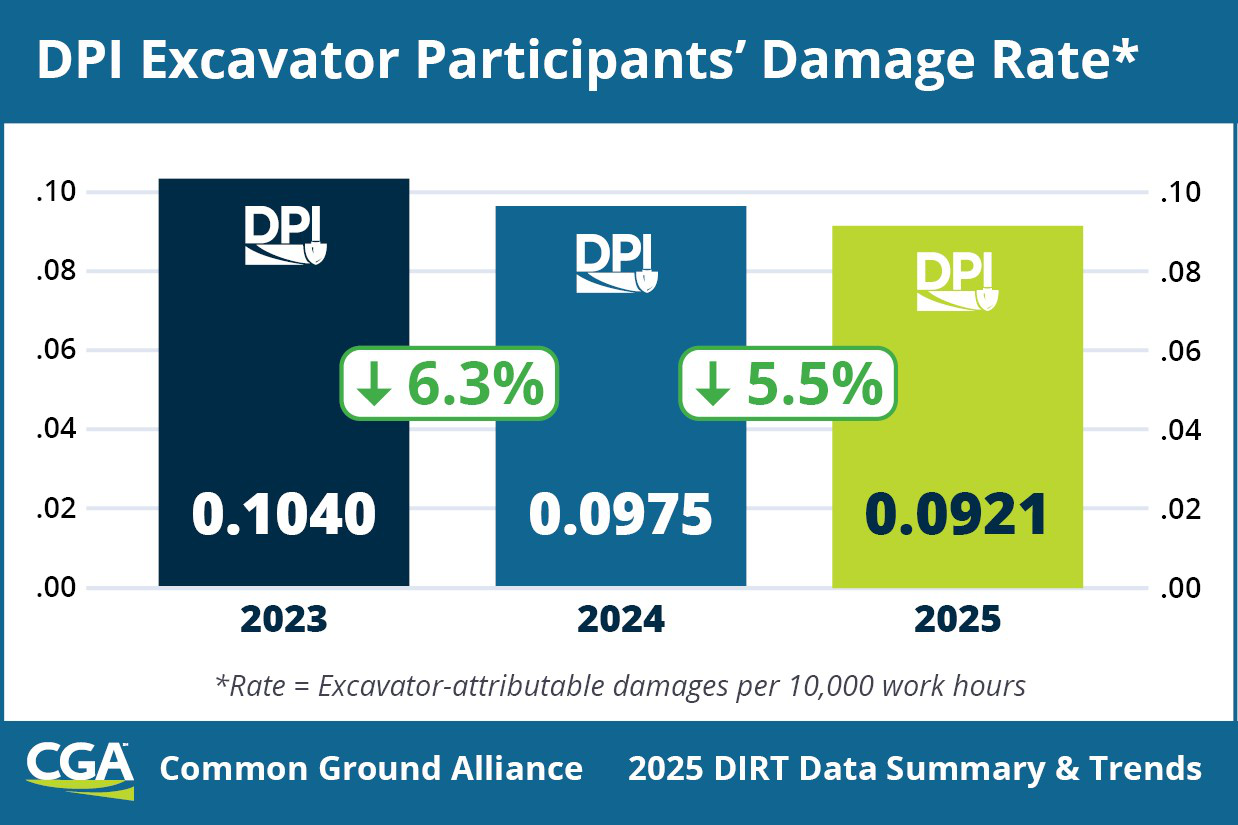
The CGA’s Damage Prevention Institute (DPI) tracks excavator participant damage rates year over year. The 2025 DIRT report shows improvement in those rates from 2023 through 2025 among participating excavators, measured as excavator-attributable damages per 10,000 work hours. The trend is directionally encouraging. It also confirms what Levendos has observed across nearly four decades: when organizations commit to the process, the outcomes improve.
Why Safe Digging Requires Industry-Wide Coordination
No single operator, contractor, or municipality can prevent utility strikes alone. Underground infrastructure is layered. Fiber runs alongside gas lines, water mains, and electric conduits, each owned by different organizations and mapped to different levels of precision.
As Levendos puts it: “Preventing utility strikes requires coordination across private and public underground network operators to communicate and identify what cannot be readily seen or understood.”
Underground infrastructure is out of sight, but that does not mean it should be out of mind. Good coordination brings it to light before excavation starts. Without it, locators work with incomplete information, and contractors have no way to know what risks lie below.
The 2025 DIRT dataset draws from facility operators, excavators, locators, and 811 centers, each contributing records and each seeing a different piece of the same problem. Effective damage prevention depends on all of them. The 811 system provides the framework. Consistent participation makes it work.
The Policy Case for Stricter 811 Compliance
Levendos is clear: “Some underground telecommunication strikes can have farther-reaching regional impacts, like disrupting wireless communication services and the ability for people to easily reach 911 emergency services. With this in mind, there needs to be stricter adherence to the 811 process to avoid such incidents.”
The CGA Index tracks annual U.S. damage trends, positioned alongside construction GDP for economic context. As construction spending grows, excavation volume grows, and so does strike exposure.
When a single utility strike can wipe out 911 access for an entire region, 811 compliance standards can’t be treated as advisory. They require enforcement with consequences proportional to the risk.
Zayo is using 8.11 Day to bring greater attention to this issue among policymakers and other network operators. The goal is systemic change: stronger requirements, clearer accountability, and policies that protect the connections communities depend on.
How To Call Before You Dig: The 811 Process, Step by Step
Regardless of project size, every excavation requires the same steps. There are no exceptions for small jobs, familiar sites, or experienced crews.
Before any digging begins:
- Call 811 at least two to three business days before excavation starts. This is a legal requirement in all 50 states.
- Wait for all facilities to be marked. Do not begin work until every underground operator in the area has responded and marked their infrastructure.
- Confirm the markout is complete. If a response is missing, follow up before proceeding.
- Respect the markings. Treat painted lines, flags, and stakes as fixed boundaries. Adjust your excavation plan to protect what has been marked.
- Dig carefully in the tolerance zone. Use hand digging or vacuum excavation near marked facilities. Power equipment is not appropriate within the tolerance zone of buried utilities.
- Re-notify if plans change. If the scope, location, or timing of your excavation shifts, call 811 again. Marks expire and conditions change.
- Report any strikes immediately. If you damage a utility, stop work, and call 911. Then notify the affected utility operator. Do not assume the damage is minor.
Each of these steps closes a gap where a strike can occur. The CGA’s DIRT data consistently traces damages back to failures at one or more of these points in the process.
Safety Is in Your Hands, Every Dig, Every Time
Underground infrastructure powers the systems that sustain daily life: communications, water, energy, and emergency services. Protecting it depends on decisions made before a single shovel enters the ground.
The 2025 DIRT report measures data quality through its Data Quality Index (DQI), which tracks the completeness of information in submitted damage records. More complete data means better analysis, better root cause identification, and ultimately better prevention. Reporting accurately is part of the work.
Levendos closes with the most important message for 8.11 Day: “Safety is in your hands, every dig, every time.”
Break ground. Not connections. Call 811 before every dig. Wait, confirm, and respect the markout. Visit the CGA’s website for additional resources on safe digging practices.